
EXPLORE OUR
Measurements
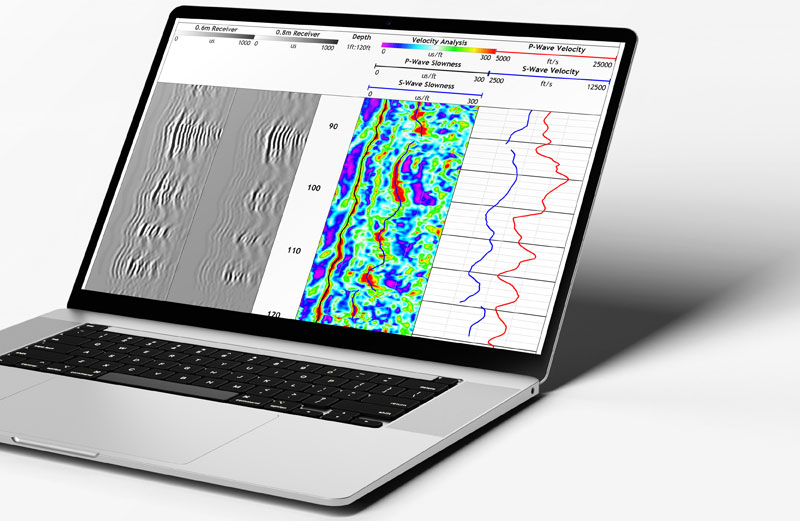
Acoustic Measurements
Description
The principle of acoustic logging relies on the generation of high-frequency sound waves and their interactions with subsurface formations. As a sound wave travels through rock, it reflects and refracts at interfaces. By measuring wave travel time and analyzing the waves as they are detected by the receiver, a range of information can be obtained and interpreted, such as formation velocity, permeability, fracture identification, casing bond evaluation, rock strength properties, depositional environment, porosity, and more.
Acoustic Measurement Tools
- Acoustic Televiewer (ATV)

- Full Waveform Sonic
- Cement Bond Log (CBL)
- Crosshole Sonic
- Borehole Sonar
- Variable Density Log (VDL)
- P-S Suspension Logger
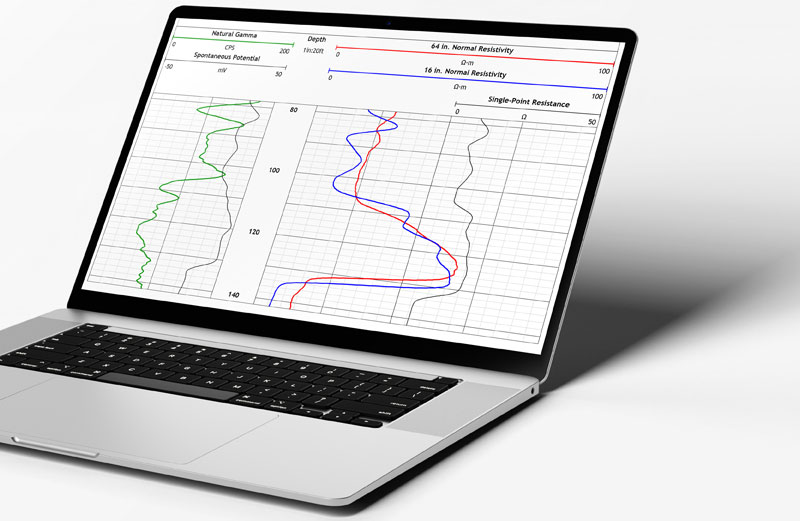
Electric & Magnetic Measurements
Description
Information is provided by measuring potential differences caused by the flow of electricity through formations. By using different configurations of surface/downhole electrodes and multi-spaced electromagnetic coils, a variety of measurements can be obtained. These measurements are used for stratigraphic correlations, lithology and mineral identification, shale/clay content, porosity, and formation water quality.
Electric & Magnetic Measurement Tools & Specs
- Electric Log (Normal Resistivity, Spontaneous Potential, SPR)
- Lateral Resistivity
- Guard (Focused) Resistivity
- Microresistivity
- Induced Polarization (IP)
- Induction (EM39)
- Dual Induction
- Magnetic Susceptibility
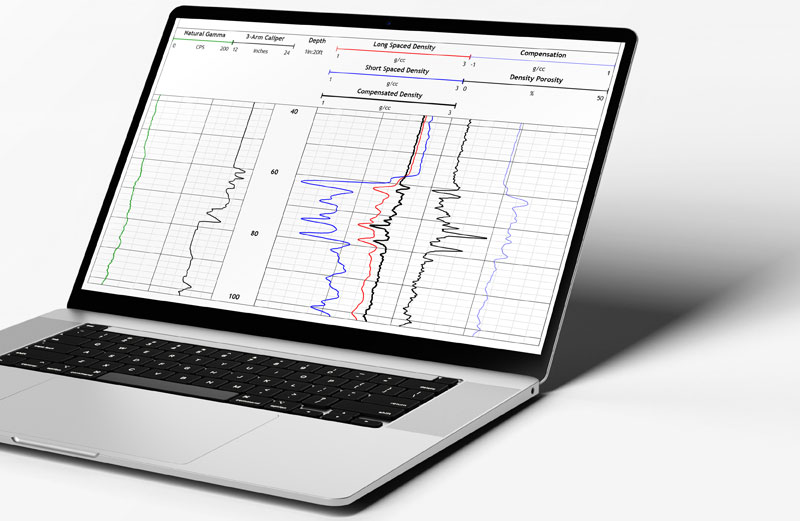
Nuclear Measurements
Description
Nuclear logging involves detection or creation of unstable isotopes in the vicinity of the borehole. Unique because they can detect formation properties through casing, these logs can be collected regardless of the presence of borehole fluids. The information obtained creates databases used for stratigraphic correlations, structure evaluation, depositional environment, shale/clay content, bulk density, rock strength, porosity, clay typing, mineral identification, moisture content, casing evaluation, well completion, and radioactive contaminations.
Nuclear Measurement Tools & Specs
- Natural Gamma
- Neutron Porosity (Thermal and Epi-thermal)
- Spectral Gamma (KUT)
- 4-pi Gamma-Gamma Density
- Focused Density
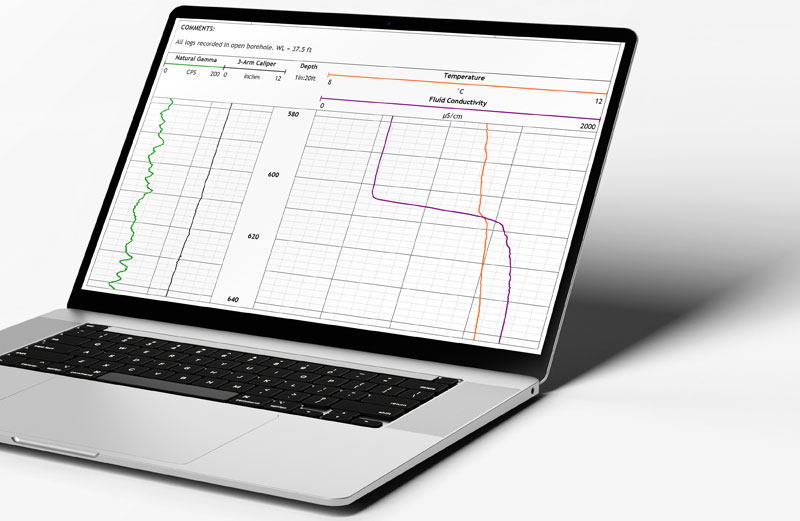
Fluid Measurements
Description
Many different types of tools and techniques can be used for the determination of fluid flow conditions in a borehole, between boreholes and correlation of flow across sites. By quantifying interval specific flow rates, fluid temperature gradients, water level/water table information, and water quality issues, conclusions can be drawn as to the aquifer characterization, well production parameters, fracture inter-connectiveness, permeability, water contamination issues and well rehabilitation.
Fluid Measurement Tools
- Corehole Dynamic Flowmeter (CDFM)
- Colloidal Borescore Flowmeter (CBFM)
- HydroPhysical™ Well Logging (HpL™)
- Temperature/Differential Temperature
- Fluid Resistivity/Conductivity
- Flowmeter (Heat-Pulse, Spinner, CDFM)
- Multi-Parameter Water Quality (pH, Redox, Oxygen)
- Discrete Interval Sampling
- Wireline Straddle Packer (WSP) Testing
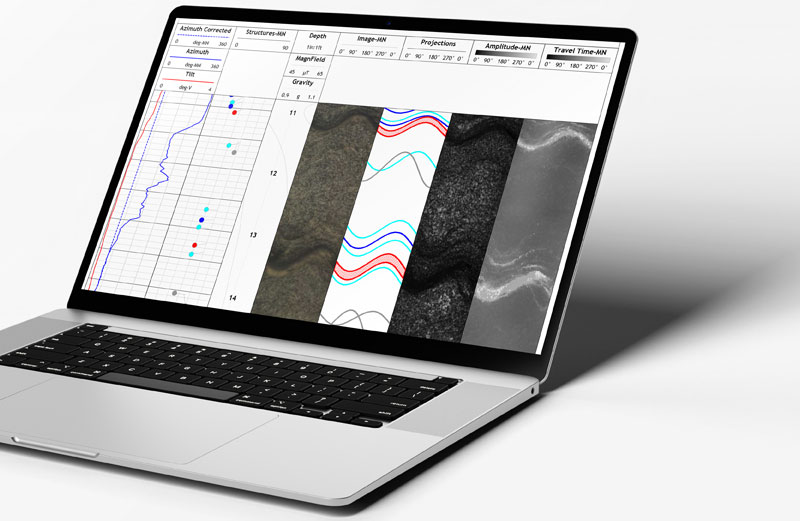
Imaging & Auxiliary Measurements
Description
Auxiliary measurements are support logs. The majority of these tools have mechanical or optical measuring devices. Applications include borehole diameter/volume, breakouts/fracture identification, casing evaluations, fracture orientation/characterization, well deviation, magnetic anomalies, etc.
Imaging & Auxiliary Measurement Tools
- Optical Televiewer OBI-40
- Video Inspections
- Rock Pressuremeter / Dilatometer
- Casing Collar Locator
- Deviation/ Inclination
- Caliper/ Borehole Volume
- Borehole LiDAR