
SERVICES
Lithium Exploration
Take your lithium exploration project to new depths with the BRINE™ Suite – engineered for precision and reliability in the harshest borehole environments.
The Brine Resource Investigation & NMR Evaluation (BRINE™) Suite is COLOG’s field-proven ensemble of geophysical tools designed specifically for the harsh conditions inherent to lithium resource exploration. Built to deliver high-quality, decision-ready data, this suite can provide ten borehole measurements with as few as three probes. For projects requiring deeper hydrogeologic insight, the BRINE Suite can be augmented with Wireline Straddle-Packer (WSP) testing, enabling interval-specific flow measurements and discreet fluid sampling.
COLOG has successfully deployed the BRINE Suite at several lithium exploration projects throughout the United States, consistently delivering reliable and insightful subsurface data in some of the harshest and most challenging borehole environments encountered in the industry. See our ‘Projects’ page for more information on COLOG’s field experiences with the BRINE Suite.
Quick Links
- Printable BRINE™ Suite Spec Sheet (coming soon)
- Logging in Brine-Rich Environments Presentation

- Our Projects Page
What makes subsurface investigation challenging in lithium exploration?
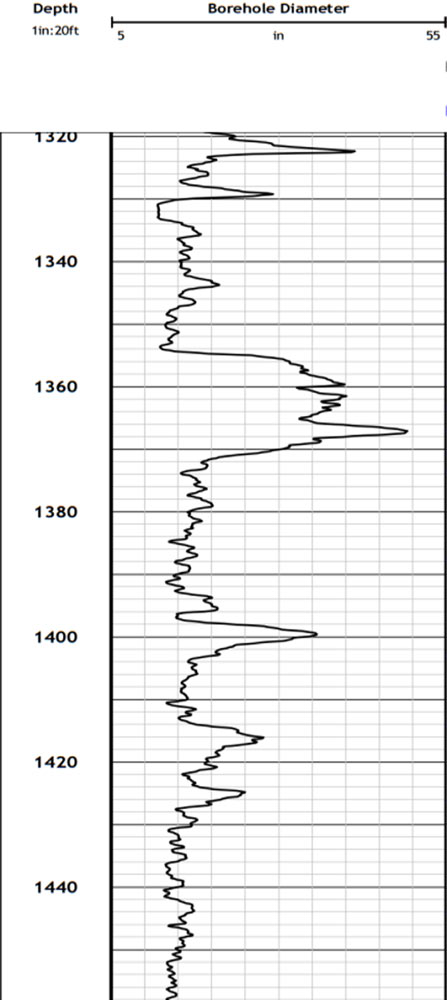
Hole conditions caused this section of borehole to exceed 40″ in diameter!
Lithium basins are typically highly saline, with fluid conductivities reaching 200,000 µS/cm. Highly conductive borehole and formation fluids tend to short-circuit electric resistivity probes such as the Normal Resistivity, Guard/Focused Resistivity and Laterologs. Additionally, with regards to Magnetic Resonance technology, the highly conductive environment causes attenuation of the EM field, called the EM Skin Effect. The EM Skin Effect reduces the signal-to-noise ratio in Magnetic Resonance technologies looking to determine porosity and permeability.
By nature of the depositional environments that accumulate lithium, lithium basins tend to consist of poorly sorted and weakly-cemented sedimentary deposits. These deposits often result in unstable borehole conditions that make it challenging to maintain an open borehole for logging. Consequently, the chances of successfully implementing traditional flow-logging techniques (Spinner, Heat-Pulse, or EM Flowmeters) to assess the vertical distribution of permeability and groundwater flow are dramatically reduced.
Why does COLOG’s BRINE Suite work so well?
Rather than using more standard resistivity probes, this suite utilizes a Microresistivity probe. The microresistivity probe uses a deployable arm to press a flexible electrode-embedded pad against the borehole wall, preventing the highly-saline borehole fluids from diverting current flow away from the formation. The probe simultaneously collects natural gamma data, and the deployable arm also functions as a single-arm caliper, allowing for basic borehole geometry profiling. Three- or four-arm caliper probes can also be deployed, supplementing the dataset with a more detailed borehole geometry profile. The microresistivity probe can obtain valuable formation-resistivity information in this challenging environment, significantly enhancing any geologist’s model of the basin lithology.
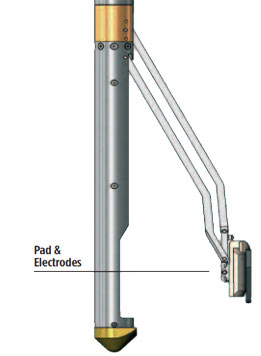
Microresistivity probe with electrode pad deployed.
When it comes to borehole Nuclear Magnetic Resonance (NMR) logging, there are several factors to consider when choosing a probe manufacturer. COLOG uses Vista Clara NMR systems for several reasons; one important reason in terms of lithium exploration is the exceptionally low operating frequency of their NMR technology. The lower the operating frequency, the less effect the highly saline environment has on the signal-to-noise ratio (SNR). The NMR system employed by COLOG operates below the AM spectrum band, keeping the SNR high. Moreover, this NMR technology uses two or three different frequencies per probe, allowing for multiple different depths of investigation. Having multiple operating frequencies also allows for an increased SNR, ensuring the most reliable data is collected. The Vista Clara NMR technology employed by COLOG has proven countless times to yield extremely valuable, high-quality porosity differentiation and permeability information in Lithium basins.
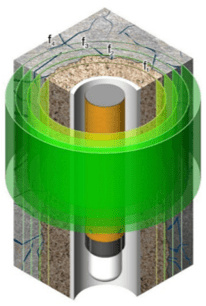
Illustration of the NMR’s multiple depths of investigation.
By combining all available geophysical logs, a clear picture emerges of the higher-yielding zones within the formation, allowing for efficient targeting of Wireline Straddle-Packer (WSP) testing and sampling. The interval length between the packers is selected based on these data and set at the surface prior to testing. The WSP assembly is then rapidly and efficiently deployed using COLOG’s truck-mounted wireline system, ensuring accurate and precise depth control. During pumping on a specific interval, pressures within the zone of interest—as well as in the intervals above and below it—are monitored to detect any hydraulic communication between the test interval and adjacent intervals. In addition, the extracted groundwater is monitored for parameters such as salinity, temperature, pH, redox potential, dissolved oxygen, and turbidity to identify and confirm when resident groundwater from the targeted interval has reached the surface.
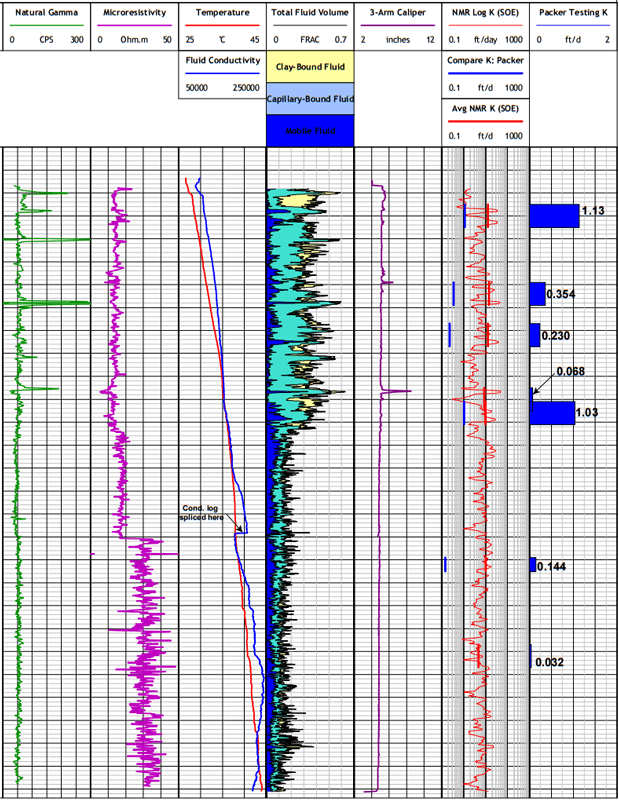
BRINE Suite summary log, including WSP results.
Ready to discuss your lithium project?
To reach a COLOG representative and discuss how the BRINE Suite can enhance your lithium exploration project, please visit our Contact Us page and fill out the form there. We will get back to you as soon as we can.